Chapter 01 · The premise
Independent project · Cinematic branching learning simulation
The First Sentence
“Yesterday, you were a teammate. Today, you’re their supervisor.”
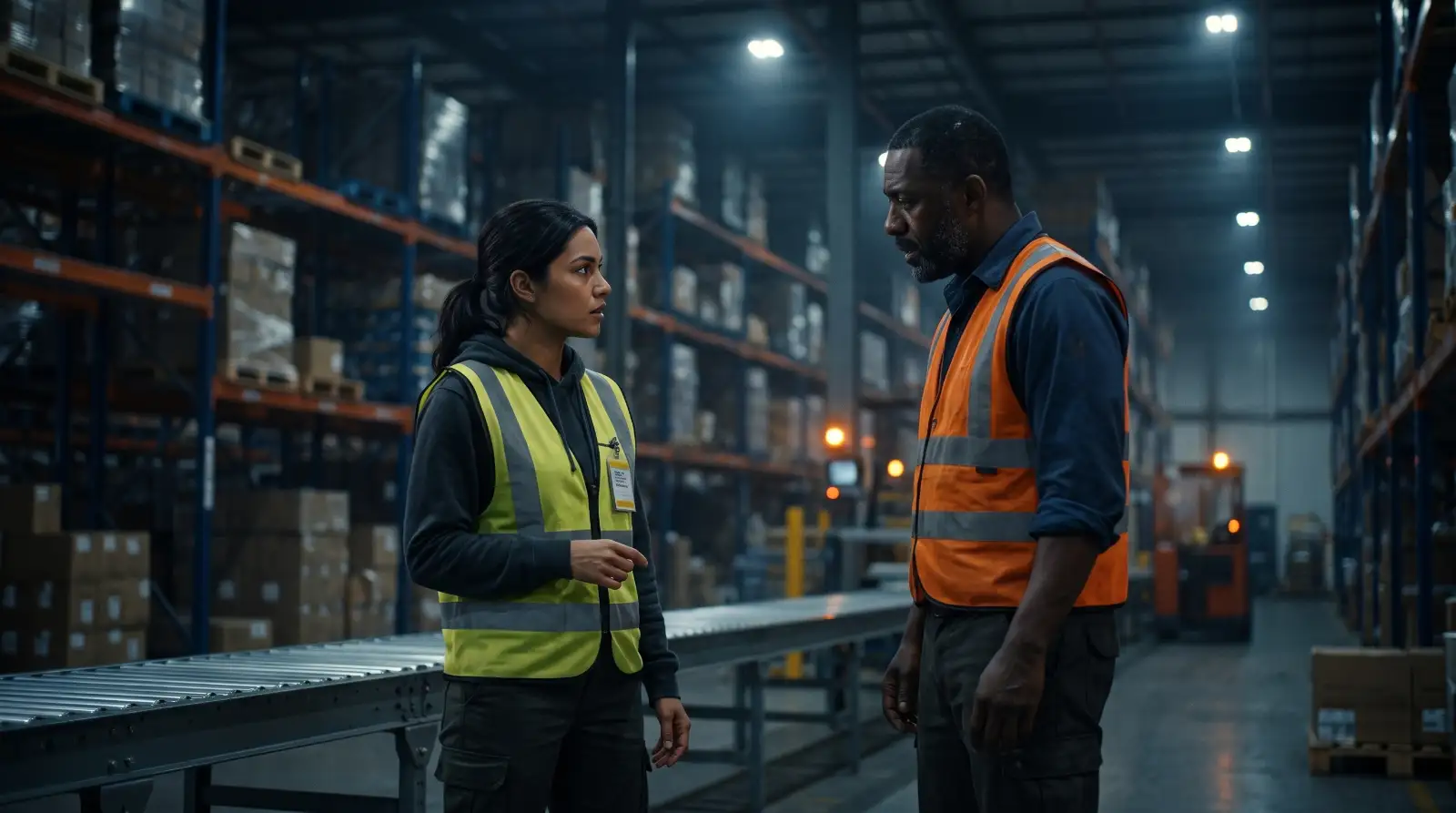
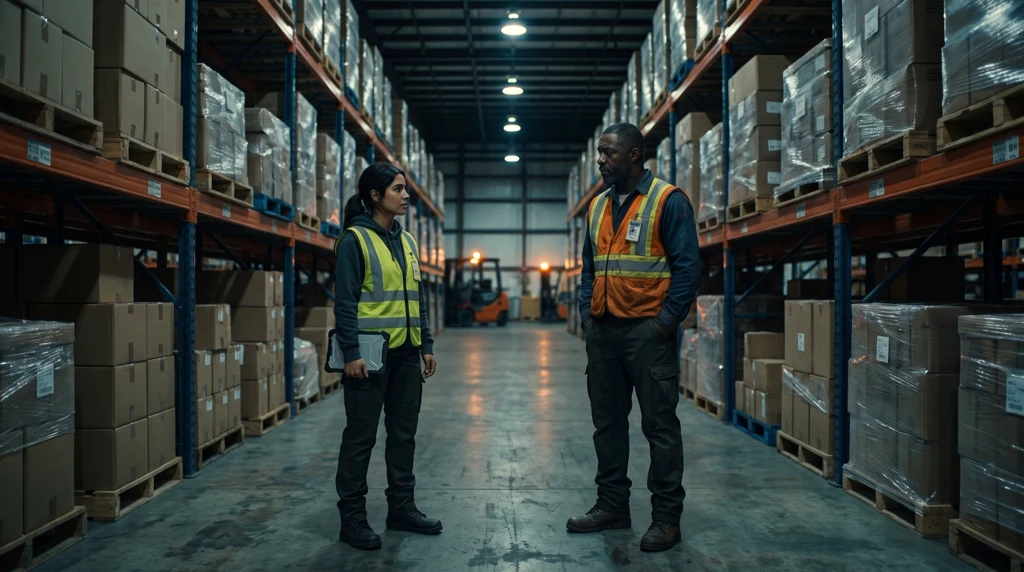
Shift 01, 06:42 AM, Aisle 04 at Northstar Distribution. Dana R. is on her first day as shift lead. Pick rate in her aisle is down 30% over three weeks, two trailers are waiting at the dock, and the night cutoff was missed by 15 minutes.
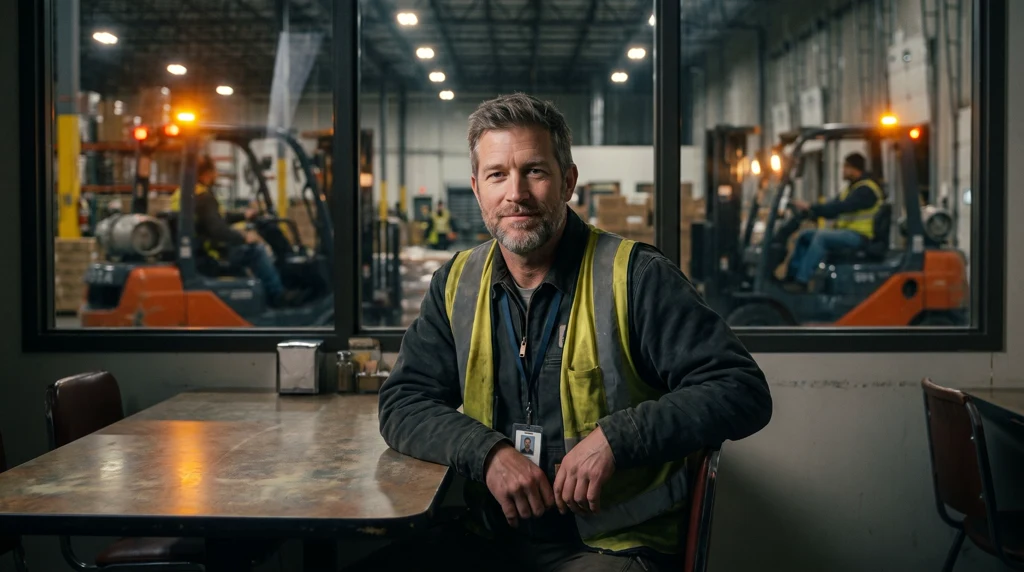
The associate behind the numbers is Marcus T., a picker with nine years on the floor. He trained her on her first day. The learner plays Dana, and has to open the conversation.
Northstar Distribution is a fictional company and Dana and Marcus are fictional characters. This is an independent prototype, not client work.
- Designed, written and produced by
- Jonathan Iker Zamarripa
- Audience
- Newly promoted frontline supervisors in distribution centers
- Objective
- Open an accountability conversation using Behavior → Impact → Ask
- Format
- Interactive branching simulation, about 7 minutes, English and Spanish
- Built with
- Figma Make, with AI-assisted video and voice production
Chapter 02 · Experience the scenario
Play it before you read about it.
The live prototype, playable on this page. Nothing loads until you begin.
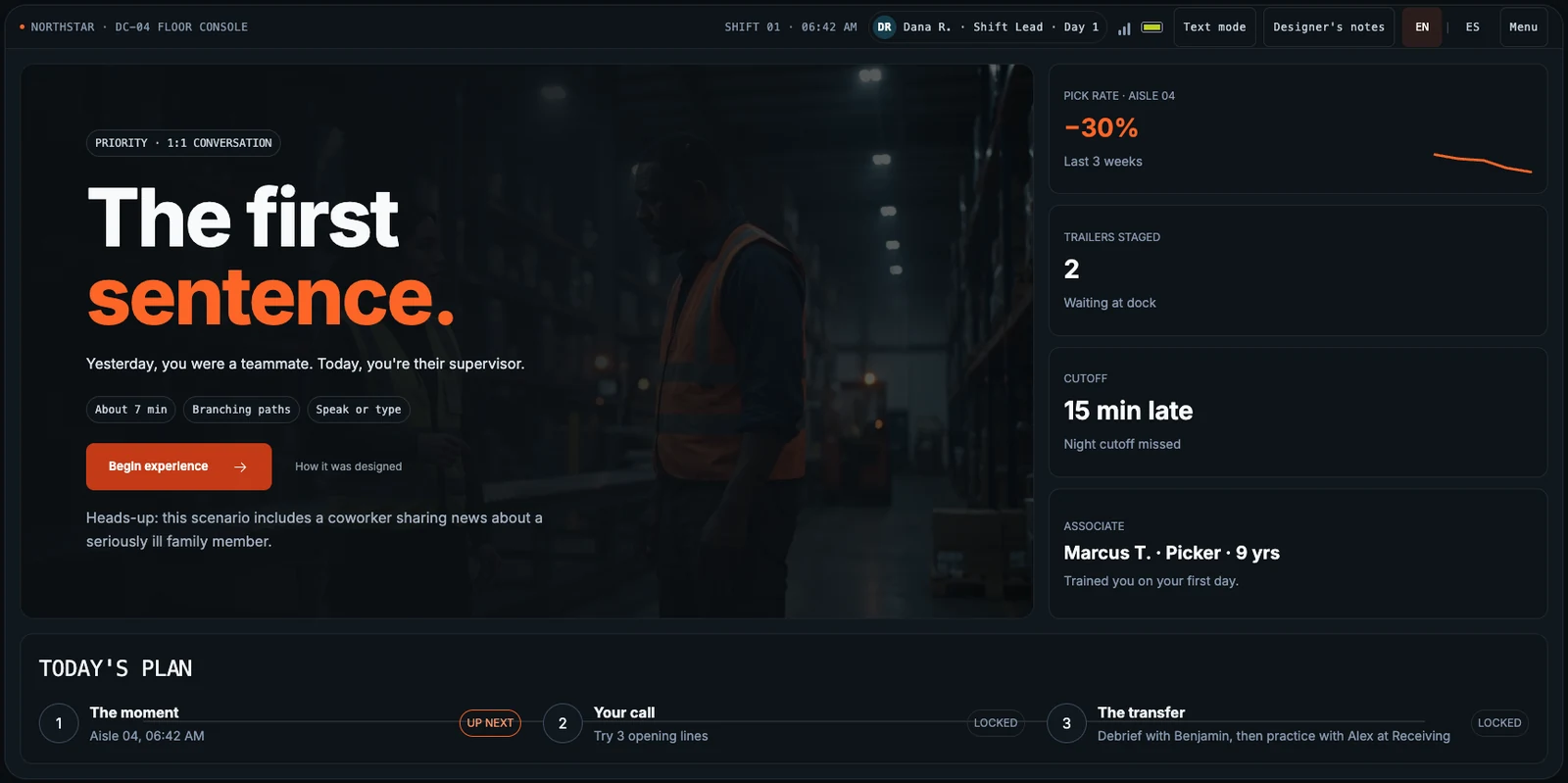
Live prototype · About 7 min · Speak or type
Step into Dana’s first difficult conversation.
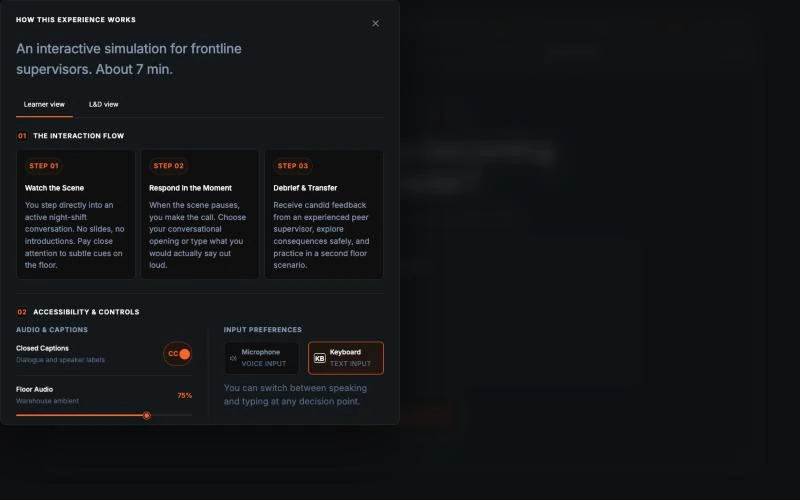
- Enter as DanaDay one as shift lead. Aisle 04, 06:42 AM.
- ObserveWatch the scene as timed cards surface the facts.
- ChoosePreview three opening lines, then commit to one.
- ReflectSee the consequence, debrief with Benjamin, try your own line.
The experience runs on Figma Sites at drums-plant-63973620.figma.site. Nothing from that site loads until you begin, and sound plays only when you start a scene. Heads-up: the scenario includes a coworker sharing news about a seriously ill family member.
Chapter 03 · Inside the decision
Six moments that make the decision.
Explore each part of the experience without playing it through.
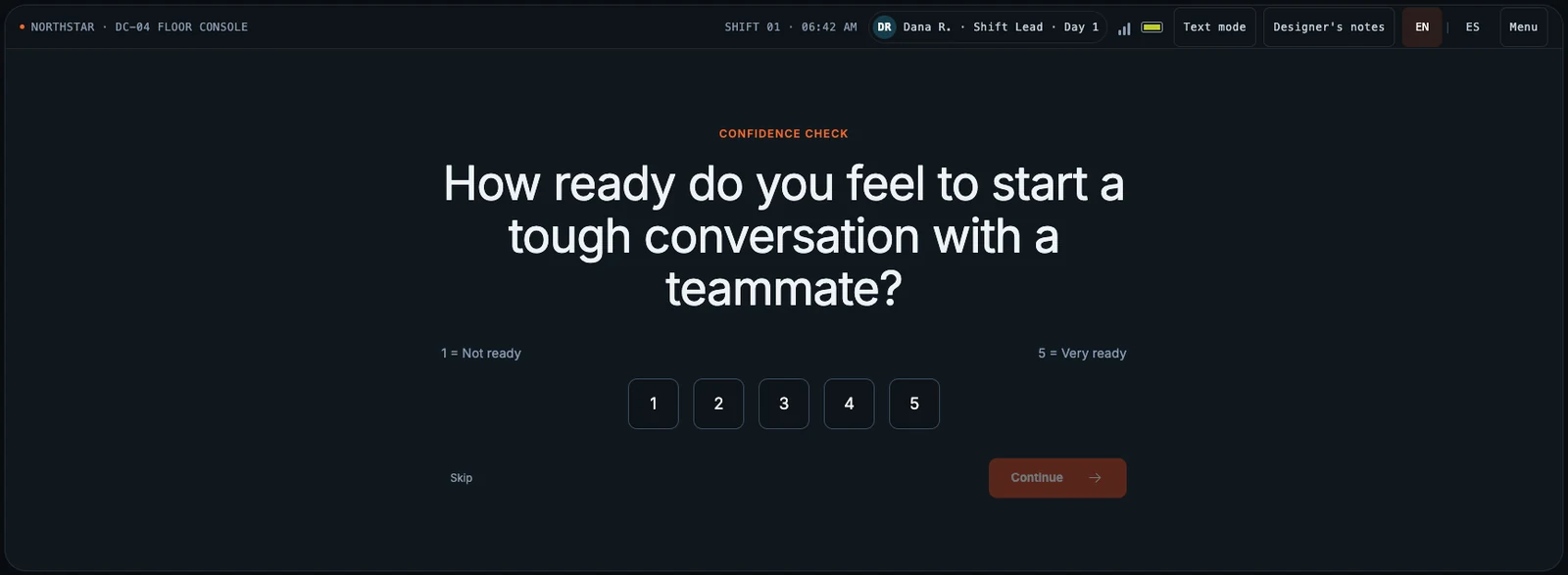
A self-rating before and after
Before the scene, learners rate how ready they feel to start a tough conversation with a teammate (1 = Not ready, 5 = Very ready). The same question returns at the end, so the experience can record a before-and-after self-report.
It can be skipped. It is a self-rating, not a measure of skill.
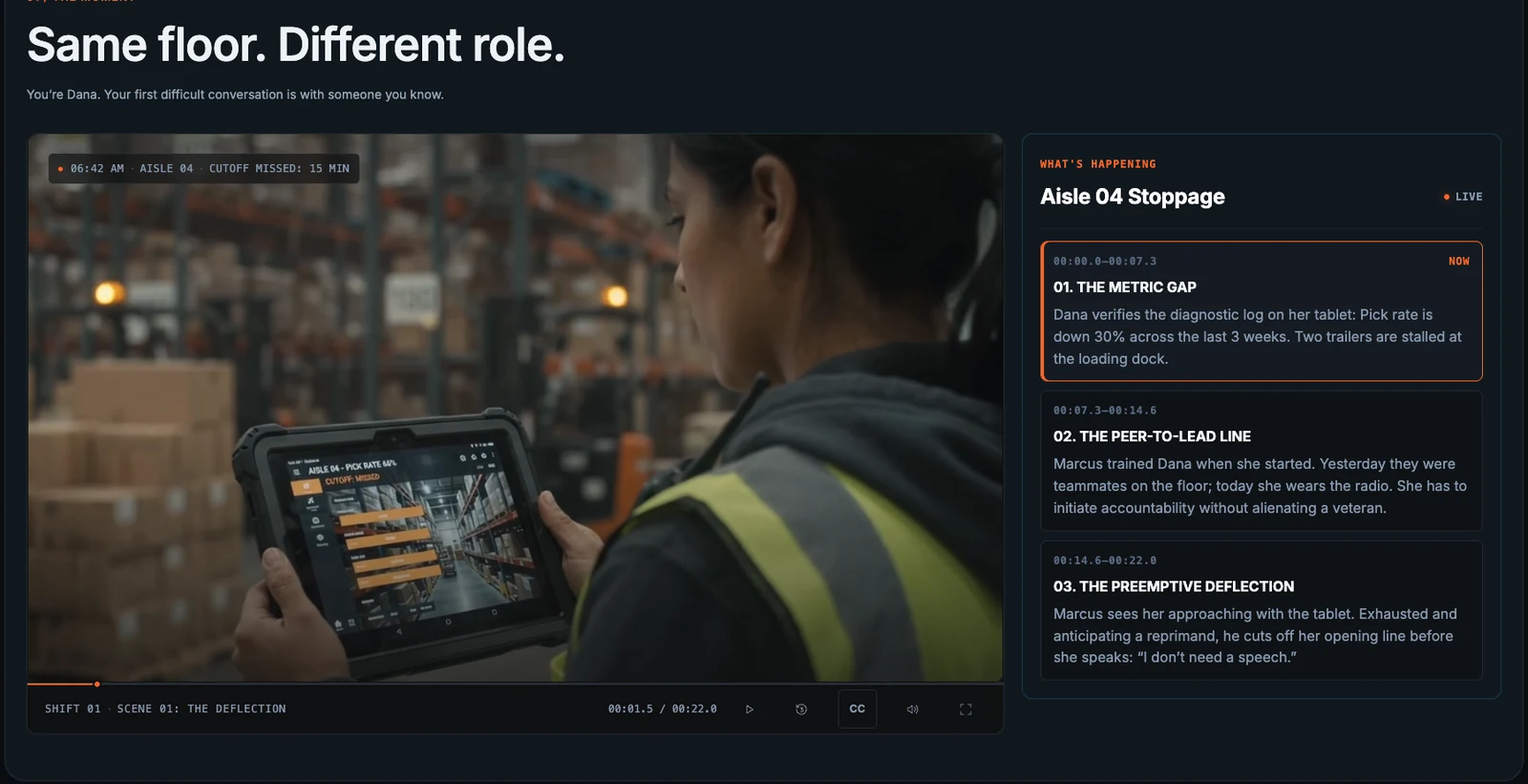
The facts on cards, the emotion on screen
The opening scene plays beside a live “What’s happening” panel. Its cards are timed to the video and highlight as each beat plays: 01 The Metric Gap, 02 The Peer-to-Lead Line, 03 The Preemptive Deflection.
The designer’s note for this screen: “Context cards carry the facts so the video can carry the emotion.”
- 01. The Metric GapDana verifies the diagnostic log on her tablet: Pick rate is down 30% across the last 3 weeks. Two trailers are stalled at the loading dock.
- 02. The Peer-to-Lead LineMarcus trained Dana when she started. Yesterday they were teammates on the floor; today she wears the radio. She has to initiate accountability without alienating a veteran.
- 03. The Preemptive DeflectionMarcus sees her approaching with the tablet. Exhausted and anticipating a reprimand, he cuts off her opening line before she speaks: “I don’t need a speech.”
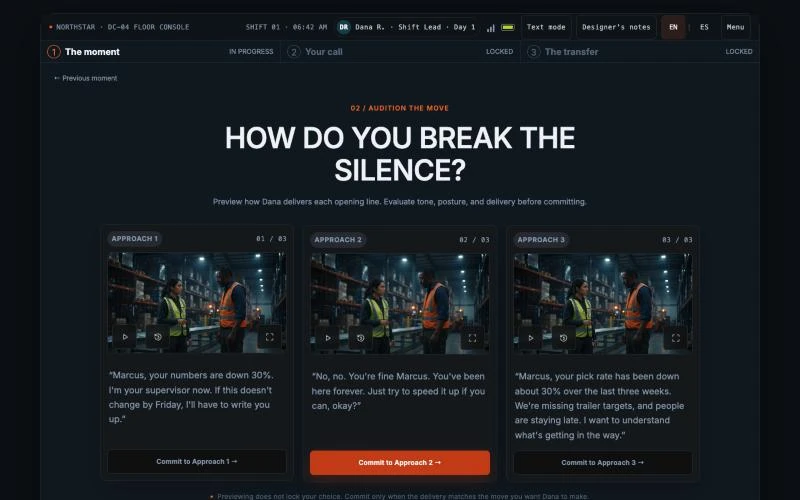
Audition the move before committing
“How do you break the silence?” Each of three opening lines comes with a short video of Dana delivering it. Learners can preview every delivery before committing, so they judge tone, posture and delivery, not just words.
Approach labels stay hidden and the order is shuffled, so the right answer isn’t telegraphed. Previewing does not lock a choice.
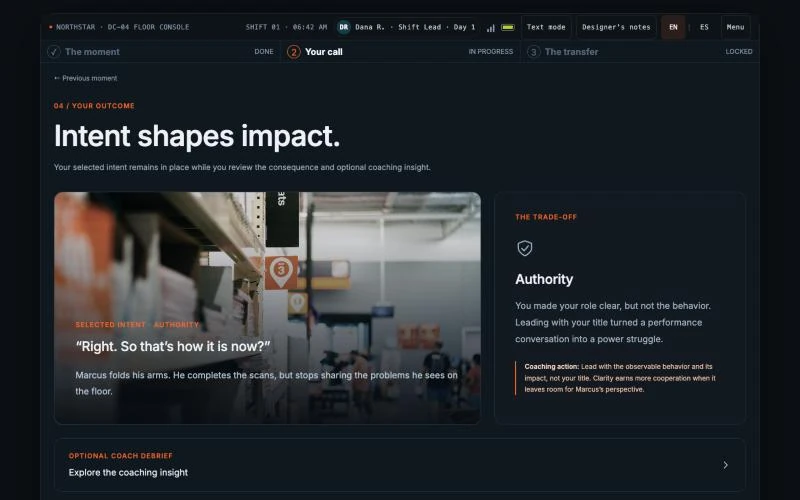
Every choice plays out in full
After committing, the chosen opening plays as a full sequence, then an outcome screen shows Marcus’s reply, what happens on the floor next, the trade-off, and a coaching action.
Wrong choices aren’t cut short; each path reaches coaching. There are no dead ends.
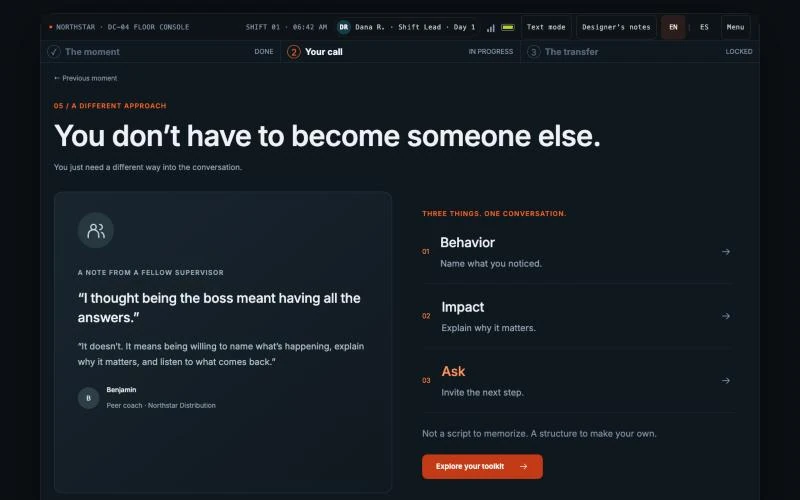
Coaching from a peer, not an authority
Benjamin, a peer coach at Northstar, frames the lesson as one supervisor to another: “I thought being the boss meant having all the answers.” — “It doesn’t. It means being willing to name what’s happening, explain why it matters, and listen to what comes back.”
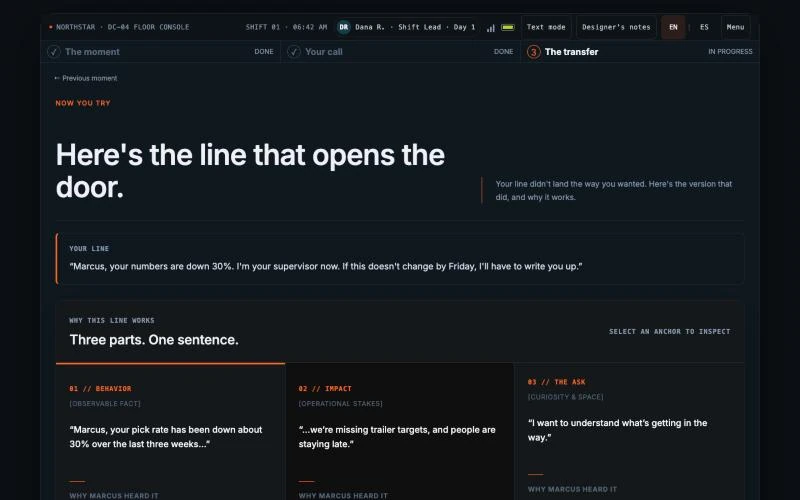
The structure follows: Behavior (name what you noticed), Impact (explain why it matters), Ask (invite the next step). “Not a script to memorize. A structure to make your own.”
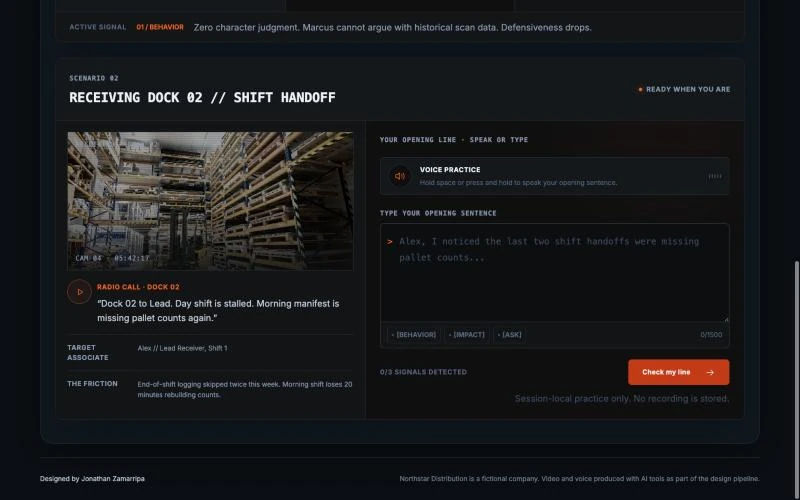
A second scenario, in the learner’s own words
The transfer moves to a new situation: a radio call from Receiving Dock 02 about missing pallet counts, and a conversation with Alex, a lead receiver. Learners speak or type their own opening sentence.
Feedback checks for the three anchors with simple word cues and says so on screen: “This is a practice guide, not a judgment. Feedback uses simple word cues, not AI assessment.” Practice is session-local; no recording is stored.
The experience closes on identity — “Who are you becoming as a leader?” — and a conversation toolkit to keep.
Three openings, three outcomes
The same moment, delivered three ways. Lines, replies and coaching are quoted from the prototype.
Soften
Nervous half-smile · softened posture
“No, no. You’re fine Marcus. You’ve been here forever. Just try to speed it up if you can, okay?”
- Marcus
- “Yeah, of course. We’re good.”
- What happens next
- Marcus gives you a familiar smile. The conversation feels easy. But the next shift, the scans are late again.
- The trade-off
- You protected the friendship. But “if you can” made the expectation optional. Marcus heard reassurance, not a request for change.
- Benjamin
- You were trying to protect the relationship. Marcus needed to hear that the relationship could hold a clear expectation.
Structured Redirect
Calm · direct · conversational
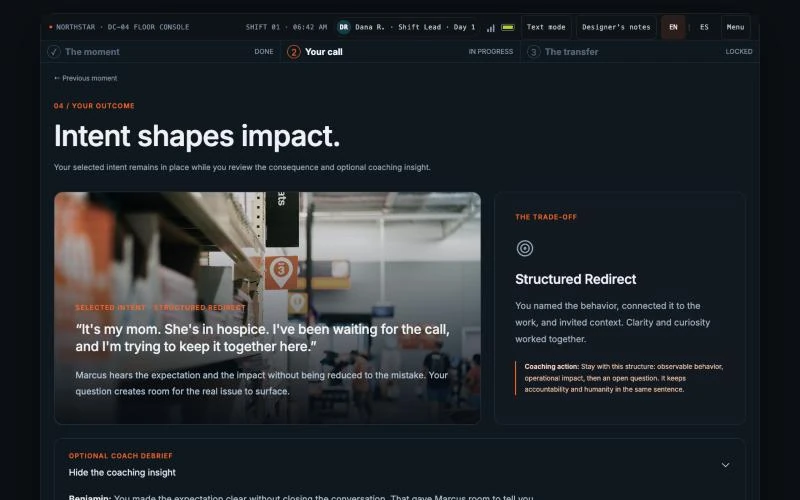
“Marcus, your pick rate has been down about 30% over the last three weeks. We’re missing trailer targets, and people are staying late. I want to understand what’s getting in the way.”
- Marcus
- “It’s my mom. She’s in hospice. I’ve been waiting for the call, and I’m trying to keep it together here.”
- What happens next
- Marcus hears the expectation and the impact without being reduced to the mistake. Your question creates room for the real issue to surface.
- The trade-off
- You named the behavior, connected it to the work, and invited context. Clarity and curiosity worked together.
- Benjamin
- You made the expectation clear without closing the conversation. That gave Marcus room to tell you what was really happening.
Chapter 04 · Creative production
One person, one pipeline: design, film and build.
Instructional design, cinematic production and AI-native development were handled in one pipeline by one designer, then implemented in Figma Make.
Visual direction
The interface is a Northstar “DC-04 floor console”: a tablet console, matching what a shift lead actually uses on the floor. Metrics, cutoffs and the associate’s record sit beside the scene, as they would on shift.
Performance direction
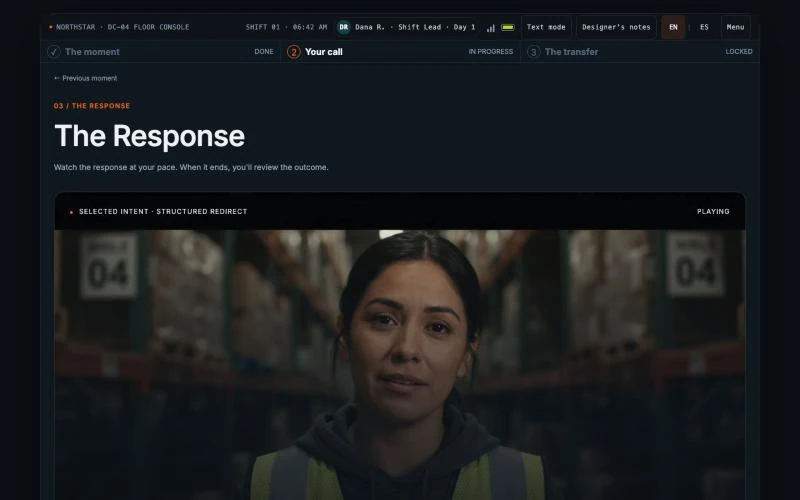
Each opening is the same line of thought performed three ways, and each delivery has its own direction: “Nervous half-smile · softened posture”, “Rigid posture · firm expression”, “Calm · direct · conversational”.
AI-generated video and voice
Scene video and character voice were produced with AI tools as part of the design pipeline, and the prototype says so on every screen. Northstar is fictional, and the characters are composites.
Interaction and state
Three stages unlock in order — The moment, Your call, The transfer — with a visible plan, a way back to the previous moment, and a resume point. Approach labels are hidden and shuffled; every path reaches coaching.
Accessibility
Closed captions with speaker labels, a text mode, voice or keyboard input at any decision point, adjustable floor audio, English and Spanish, a content heads-up before the scene, and an Employee Assistance Program note for anyone the story touches.
Designer’s notes
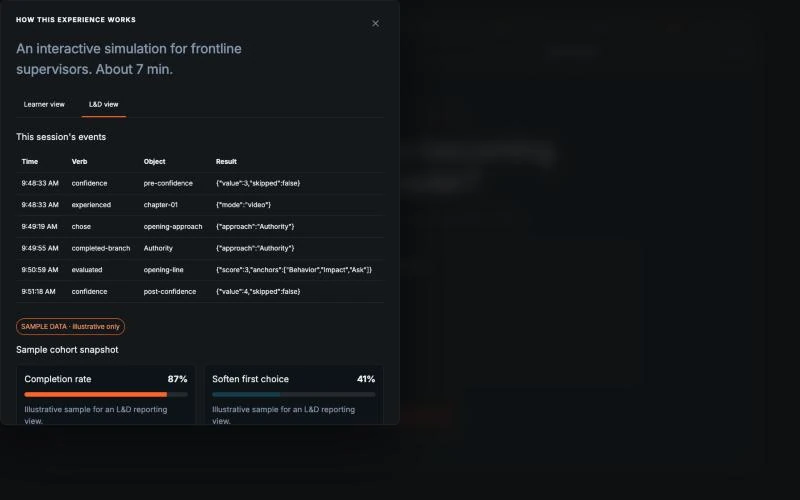
A notes panel on every screen explains why it works, and an L&D view shows the session’s events as they happen — the experience documents its own reasoning.
Chapter 05 · What the project demonstrates
Design hypotheses, not proven results.
No learner outcome data is reported for this prototype. These are the bets it makes, the research each bet leans on, and what is still open.
Enter the moment first
The learner is inside the scene before any instruction. The prototype cites narrative transportation (Green & Brock, 2000).
Let wrong choices play out
Missteps run to their consequence, then get a specific debrief. The prototype cites productive failure (Kapur, 2016).
Model from a peer
Benjamin coaches as a fellow supervisor, not an authority figure.
One structure, not a script
Behavior → Impact → Ask is reusable in the next conversation; the transfer scenario tests exactly that.
Close on identity
“Who are you becoming as a leader?” turns a skill into a commitment, followed by a toolkit for on-the-job reference.
Be honest about feedback
Feedback looks for the three anchors with word cues and is labeled that way — not presented as AI judgment.
Implemented in the prototype
- Opening scene with timed context cards
- Three previewable openings, each with a full consequence sequence
- Outcome, trade-off and coaching for every path
- Peer debrief, toolkit, transfer scenario and identity reflection
- Before-and-after confidence self-rating
- Voice or typed input with word-cue feedback; session-local, nothing recorded
- Captions, text mode, English/Spanish, designer’s notes
Concept only
- The L&D view is a designed reporting concept: it lists the current session’s events (verb, object, result). It is not presented as a deployed LMS or learning-record-store integration.
- Its cohort snapshot is labeled “Sample data · illustrative only”. Those figures are not results.
- No effectiveness data is reported. Whether the experience changes on-the-job conversations is untested here.
Still open
- Does practicing the opening line change what a new supervisor actually says on the floor?
- Does a before-and-after self-rating reflect skill, or only confidence?
- How much does word-cue feedback miss when a learner phrases an anchor in their own way?
Disclosures: Northstar Distribution is fictional. Dana, Marcus, Benjamin and Alex are fictional, composite characters. Video, voice and character imagery were produced with AI tools. The prototype is an independent project, not client work.
Chapter 06 · Explore more